A Lab and a Marketplace
Built 115 UI components in three days, shipped Breakscale as a VS Code extension and an MCP server, and got into the Vercel OSS program.
Exams finished last Sunday. This is what happened when the brakes came off.
ui lab
lab.xevrion.dev. It started Tuesday night as an empty Next.js starter with six components in it.
By Thursday it had 115 interaction components, each one with its source, keyboard support, light and dark themes, and a demo you can actually poke at.
It is not a component library. It's a lab. Whatever I find cool or interesting on the web, I rebuild it there to understand how it works. It's at 59 stars and open source, and I'd genuinely like people adding their own experiments to it.
Then I used the things I'd built in the lab to rebuild this site as a minimal monochrome thing, which is the part I didn't expect. The lab paid for itself within two days.
Told myself one hour of building. It was 11pm. The hour started at 8.Breakscale, twice over
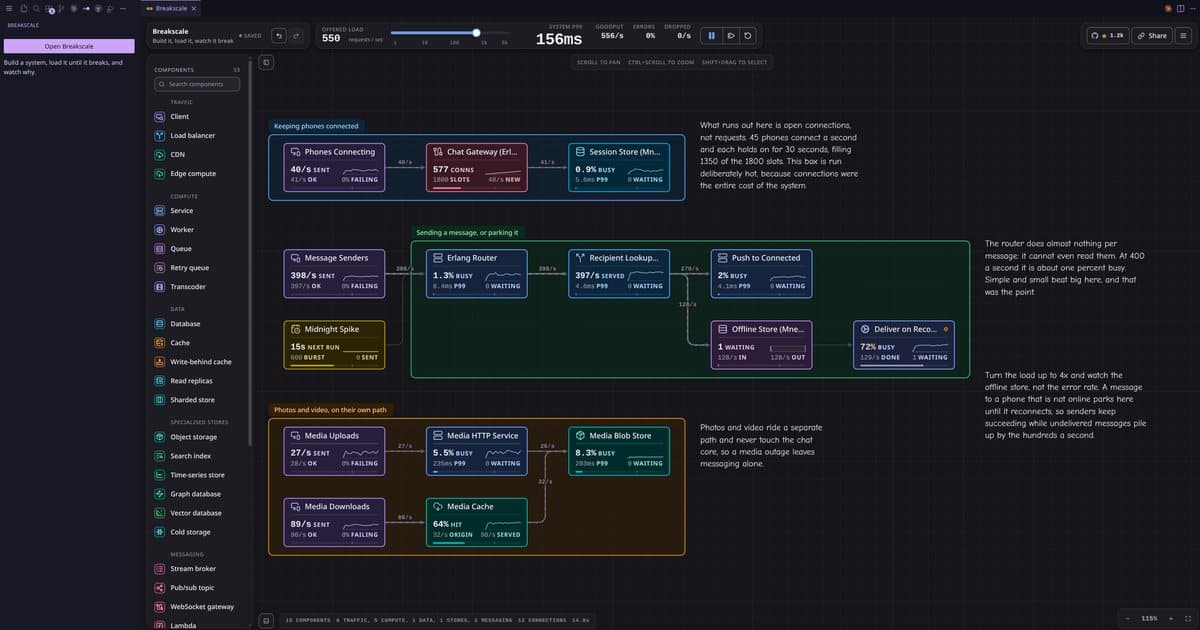
A friend commented "would love this as a VS Code extension." I said it wouldn't take long, and shipped it the same day.
Same engine as the web app, 33 components, 23 worked examples, fully offline, 446 KB. It was fast because Breakscale has no backend, so the extension is about 150 lines that open a panel and point it at the existing app.
Then on Saturday I gave it an MCP server, so an AI assistant can draw a design, run it, and change it while you talk about it.
Ask for a URL shortener at 2,000 requests a second and it goes and builds one on the canvas.
It's hosted on Vercel and currently in review for the Claude connector directory.
Vercel OSS
A month ago Breakscale had 8 stars. It's at 1,201 now, and it's in Vercel's open source program for the next twelve months.The timing was good, because I had comfortably blown through the free tier.
That makes three programs backing it, alongside Claude for OSS and Mintlify.
Traffic has settled into a long tail since the launch spike: 20,196 visitors over thirty days.
gyotaku
Read the Opus 5.5 post at 2am on Friday and decided to pull an all-nighter building the thing I'd wanted for months: search every screenshot you've ever taken by the text inside it.
gyotaku is native Linux, fully offline, written in Rust. PaddleOCR on onnx runtime reads the text, sqlite stores it, gpui draws the window. It watches your screenshot folders at idle priority, indexes in the background, pauses the backfill on battery, and stays resident after you close it so the next summon skips GPU setup.
By the end of the day it had CI building and reading a screenshot on ubuntu, debian, kali, arch, fedora and opensuse, a systemd unit, CodeQL, a contributing guide and issue templates. That felt like the right amount of seriousness for something built overnight.
Small things
- falling-sand: the mid-2000s powder toy, rebuilt from scratch with no libraries. Every pixel is dumb and the piles, puddles and fires just emerge. Nobody codes the pile, it just happens.
- delay-stego: hide a message in the gaps between packets rather than in the bytes. A tiny covert timing channel in C++, which came directly out of that steganography paper from a couple of weeks ago.
- i-finish-at: a program that prints the exact time it will finish running, then lands on it to the millisecond.
- guess-the-next-word: your phone keyboard's suggestion strip, from scratch, and it keeps learning as you type.
- edit-guard and wait-guard: two failproofai policy packs, one that steers in-place shell edits toward a proper edit tool, one that stops agents burning wall clock on sleeps that watch nothing. Both came out of running an audit on my own agent setup and scoring 31 out of 100.
- Also had a PR merged into screenshot-studio, adding a mosaic style for blur regions.
What I found interesting
- supermemory and company-brain : a memory and context engine, and a Slack teammate that remembers everything your team says.
- improve : use your most capable model to audit a codebase and write plans for cheaper models to execute.
- agent-orchestrator : run and supervise teams of coding agents across any harness.
- humanizer : an agent skill that strips the signs of AI-generated writing out of text.
- limusic : a native YouTube Music client in Tauri and Rust, ad-free through libmpv, no Electron.
- ente : end-to-end encrypted cloud for everything.
- ui-skills and reicon : skills for design engineers, and an open source icon library.
- Zed shipped a single toggle that removes every AI feature from the editor. Thanked them for it and they liked the post, which was a nice way to find out someone's listening.
Random
Got my first GitHub sponsor. One person, which is exactly one more than I had last week.
Also changed my mind about the laptop. The goals page said MacBook Air; it's a MacBook Pro 14-inch, M5, 24GB, 1TB, in space black now. More expensive, further away, correct.
Started Hack The Box Academy's Junior Cybersecurity Analyst path, which is currently 0.3% complete and therefore going extremely well.
3,948 contributions in the last year. My sleep schedule is a disaster but my GitHub looks like a well-watered lawn.
Also cut a showreel for the lab, which was fun to make and is the first video thing I've posted.
Discord says the last thing I played was Vice City, two weeks ago. That tracks.
Somebody also handed me a billion Muse tokens for redeeming a code, which I am sure will be useful for something.
Uptime counter says 15 hours 44 minutes, which for this week is honestly restrained.


Comments